Commercial Roofing for Investors and REITs in Quincy, MA
Thaw water trapped behind an old equipment pad changes a buyer's roof comparison even if the visible field has a recent coating. For a Quincy, MA, investment asset, we examine the water route, receiving construction and condition beneath the surface before assigning useful remaining service. Appearance and installation paperwork answer different questions from a physical roof assessment. The investor needs both connected to the actual assembly. A proposed renewal allowance should identify components and defects rather than assume the surface represents everything retained below it.
We inspect, repair and renew commercial roofs with the acquisition or ownership decision in view. Quincy prepares for flooding and winter storms, making low-point details and secure transitions relevant to that assessment. The roof's moisture, attachment and repairability establish the construction threshold. Tenant use establishes protection and operating exposure during work. Those findings should remain distinct enough for an investor to compare the asset's immediate needs with wider renewal.
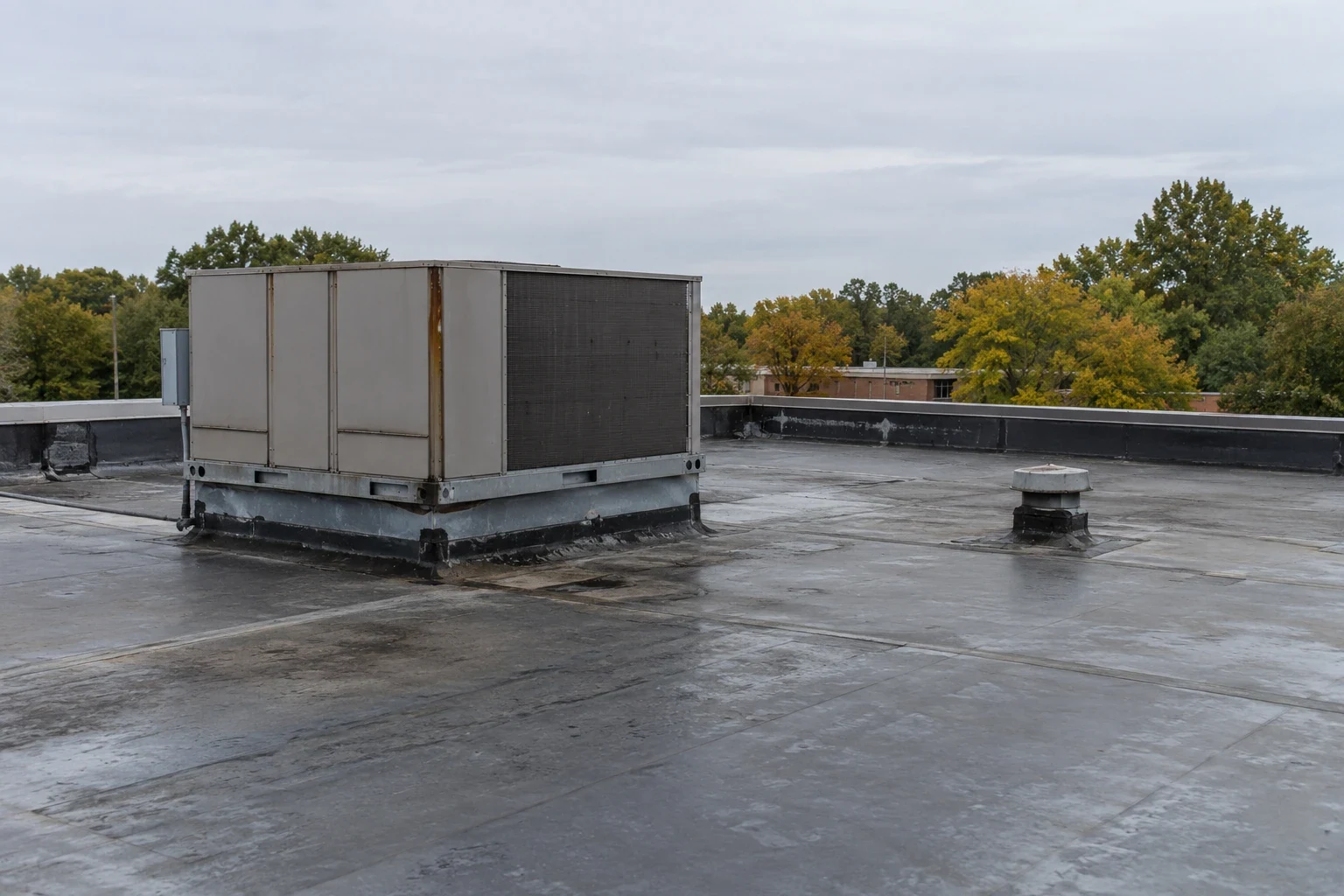
Identify the layers behind the appearance
A new-looking sheet may cover retained insulation, earlier roofing or damaged receiving material. We examine available assembly information and the physical roof before recommending retention or removal. Selective investigation can be needed to establish moisture and support where surface observations are insufficient. A continuous field does not establish that each underlying layer provides a useful base. The proposal should identify what remains in service under a recover or restoration.
Our roof due-diligence assessments connect the visible details with the assembly and areas requiring further examination. An investor can then distinguish bounded repair work from reconstruction supported by concealed findings. The decision should state which connection causes entry, which layer is damaged and which component can remain. A broad aging-roof label leaves too much of that construction comparison unresolved for an acquisition or renewal decision.
Assess the next use as well as the current roof
A planned tenant change can alter exhaust, equipment supports and access paths without replacing the roof field. We examine the proposed openings and material contact alongside current condition. A suitable existing membrane may need new details around the changed equipment. Some uses can also introduce different thermal or humidity conditions below the assembly. The roof decision should identify those interfaces early enough that a completed renewal is not immediately disturbed by the next tenant's work.
Quincy Center includes downtown offices and retail. An investment in that mixed commercial setting can need an individual examination of shared equipment and occupied rooms before construction is staged. Wollaston's older small-scale retail areas add another setting where building connections and tenant changes deserve assessment. Work in Wollaston should connect the actual roof geometry with the proposed use, without assigning a roof material or remaining service from the building's architectural age.
Compare retained components on the same basis
A repair proposal, a recover and a replacement can leave materially different construction in service. We identify removal limits, insulation condition, deck work, attachment and reconstructed flashings under each option. Drainage improvements should be described separately from a new surface. Those details let the investor compare complete scopes rather than treat the selected covering as the only meaningful difference. A useful renewal choice should resolve the physical failure mechanism behind the required work.
For roof replacement decisions, concealed deterioration can make removal more useful than retention. A dry stable receiving assembly can support a different comparison where applicable requirements allow a recover. We explain the conditions supporting each approach. Equipment clearance, outlet elevations and perimeter geometry may also change with insulation height. The revised assembly should finish at suitable connections, not preserve the same vulnerable transitions beneath new material.
Where general-contractor coordination accompanies renovation, roof openings and equipment tasks need a defined sequence. The waterproofing boundary should be completed after support or curb work that affects it. An investor should be able to identify which trade task creates an opening and which construction closes it. That clarity reduces the chance that a finished field is treated as completion while a related detail remains exposed.
Separate active entry from later surface renewal
A bounded opening above sensitive tenant equipment can need prompt intervention even while the wider roof remains serviceable. Another area may contain distributed wet insulation requiring planned reconstruction without the same immediate interior symptom. We assess both physical condition and operating exposure before ranking work. The comparison should show the component behind each priority. Urgency should not be assigned solely by how visible a stain is or how new a surface appears.
Roof capital planning can place those component decisions within the owner's renewal sequence. We identify immediate waterproofing, supported removal and any drainage or equipment correction needed. Urgent flashing work and wet-board removal can need different tenant arrangements. The decision should describe what the intervention retains, what it restores and which tenant arrangements the construction needs. Unresolved concealed condition should prompt appropriate investigation rather than a service-life guess.
After acquisition, property-management roof work can distinguish routine outlet cleaning from damaged construction needing repair. The findings should transfer clearly enough that a recurring work order is not repeatedly treated as a new isolated event. A repaired flashing, corrected support and cleared outlet are different completed tasks. The manager needs the component information that shows what was restored and what remains to be assessed.
Keep the installed assembly repairable
A warranty document needs to be read with the actual system and maintenance requirements, not treated as a substitute for condition. We examine installed-material information where it affects compatible repair methods and proposed changes. A coating or patch unsuitable for the membrane can complicate later work. Equipment additions may also affect the assembly's details. The investor should know what construction is present before relying on a familiar material name as the full roof description.
Warranty and system review can identify the relevant conditions for the installed roof and any project changes needing evaluation. We do not assume a particular coverage outcome from surface appearance. The physical repair still needs appropriate receiving material, preparation and construction. Maintenance should preserve access to outlets and vulnerable connections, with technician routes protected where concentrated contact can damage the installed assembly.
Define the exposed stage before committing timing
Before an investor commits to a renovation interval, we divide removal according to the connections that can actually be rebuilt while tenants remain in place. A roof area with several curbs may need a smaller daily opening than an unobstructed field because support work and flashing must finish together. Where construction meets a retained section, the dividing detail needs a stable receiving edge and a water route that does not discharge into the open assembly. Delivery and disposal positions should also preserve tenant entrances. Those physical staging decisions help distinguish a feasible occupied renewal from a proposed duration that assumes unrestricted access.
Commercial Roofing Questions
Does recent coating establish useful remaining service for an acquisition?
The receiving assembly still needs examination. We assess adhesion, detail condition and concealed moisture where warranted, then identify what the coating retains. A suitable restoration can be useful on sound construction, while wet or unstable layers may remain unresolved beneath a newer finish. The acquisition decision should follow those component findings rather than rely on appearance alone.
How should planned tenant equipment change the roof assessment?
We examine the new openings, supports, material exposure and service routes alongside current condition. Some changes can be detailed locally on a serviceable roof; others may affect the broader renewal scope. Coordinated support and waterproofing tasks should be identified before construction. The proposal should show how the final connection closes after the equipment work rather than leaving a newly installed field vulnerable to immediate alteration.
Can a warranty replace an inspection before purchase?
A warranty and a condition assessment answer different questions. We examine the installed assembly and any defects while reviewing material information relevant to repairs or planned changes. Coverage terms do not establish that every layer is dry, attached or suitable to retain. The buyer should compare the physical findings and the applicable system requirements together.
What should distinguish the roof options in a renewal allowance?
Identify removal, retained insulation, support work, drainage and reconstructed connections under each option. Then identify tenant protection and equipment coordination during installation. A repair, recover and replacement can retain substantially different components. We explain those differences so the investor can assess complete construction without reducing the choice to the name or color of the new surface.